Simplicity #1061 Sew Along
Saturday, November 24, 2012
The Grand Zipper Exposé...and rhinestone zipper tutorial
During a recent trip to Salt Lake City (see this post: http://www.sewchicpatterns.blogspot.com/2012/10/tissu-fine-fabric-store.html) while visiting Tissue Fabrics, Mirjam, my exchange daughter caught site of a black zipper with rhinestones on it. Not having a project in mind at the moment, we didn't buy the zipper, but thoughts of that zipper didn't leave entirely. In fact, she mentioned how perfect a rhinestone zipper would look down the back of the crepe dress we were making for her homecoming dance. The zipper we saw was only 7" long, and we needed at least 14", so a quick search revealed a seller on Etsy, LollyGagsLLC, that had rhinestone zippers for a very reasonable price. There would be some hurdles: the zipper was separating, and a little longer than we needed (15"), and we had very little time for shipping. The seller was completely accommodating, and I decided that for the price, we could overcome any other obstacles, so we placed our order, and it came right on time.
The larger rhinestones were fabulous. No missing THIS detail! Intended for jackets, separating zippers are usually bigger, but the pull on this one was enormous, nearly the size of a quarter! Okay, so add one more hurdle to the list. I suggested that we could cover it with a bow. Mirjam agreed, so life was good again.
There are plenty of tutorials on exposed zippers, but this one is a little different. First, it needed to be fitted, and I didn't want to expose any of the tape, only the rhinestones. Here is a quick over view of how I did it:
First, add fusible interfacing to the fabric edge. This stabilizes the fabric and makes it easier to fold, press, and sew with a top stitch. Make sure you've measured your opening so that the opening will end at bottom of a rhinestone. You can see that the center back seam is also sewn at this point.
Next, do a fitting to mark the center back of your dress. This makes sure that your dress will fit perfectly once the zipper is installed.
Subtract half of the width of the zipper teeth from center back marking a fold line.
Square off the bottom of the zipper opening with a stay stitch.
Clip into the seam allowance to the stay stitching. Press the sides along the foldline and press the bottom down.
Pin the zipper to the pressed opening and top stitch the zipper to the dress, first one side then the other.
Since our zipper was too long, and being made of heavy plastic, we could not sew across the bottom of this zipper. We had to hand tack it.
While I was sewing in the zipper, Mirjam was inventing a bow to go across the back. We used heavy interfacing in the bow so that it would not be limp. Mirjam was very careful to make sure the dimples were perfect. Cute bow!
The next step was to pin the bow in the right location. We tacked it to the dress on one side and placed snaps on the other.
The bow really adds something to the zipper that it wouldn't have had otherwise. Together they turned out beautiful and make quite a statement!
I do want to mention that we had other problems with this pattern, besides the one I mention here:
http://www.sewchicpatterns.blogspot.com/2012/11/when-dart-will-do.html . I found that the skirt hung badly. The bodice waistline on the bodice dips to the back quite a bit more than the skirt pattern accounts for. I had to reposition the skirt completely to keep the hem parallel to the floor. I also took out the skirt front darts. It was so high on the body that the darts were unnecessary. I also lengthened the skirt by about 2 inches.
The other thing that might be helpful to your rhinestone zipper project is that these zippers are difficult to zip up and down. With patience, you will succeed!
You can find LollyGags store here: http://www.etsy.com/shop/LollyGagsLLC
Sunday, November 18, 2012
When a dart will do.
Not long ago, high school girls everywhere were thinking about what to wear to the homecoming dance. My exchange daughter, Mirjam, chose Butterick 5601, a classic sheath with a key hole back. We left the store with black crepe and just a little trim for the waist. Then I get a phone call from my aunt who was making a dress for her granddaughter. She had some questions about how to sew with lace, and as the conversation rolled along, I realized that she was making the same pattern! We laughed and compared notes about the style and fit. She warned me that the skirt was very short, and I mentioned to her that the back yoke was missing some darts.
What? Missing darts? She noticed the sag, but didn't know what to do for it except tuck it into the seam below. Not the best solution. Anywhere our body has curves, we need a dart to shape that curve, and our shoulder (blade) is one such curve.
Notice how that saggy look goes away once I put in the dart that has been omitted? SO much better. Next I need to correct the pattern, adding in the dart. This helps make sure the two darts are marked the same and if anyone ever makes this pattern again they will know to put in a dart here.
Here's what the pattern looks like now.
Mirjam and I worked on this dress every day after she came home from school for a week. She would press and I would sew. We were quite the sewing team! In the end, we also made some styling changes, adding a unique rhinestone zipper to the back of the dress that could have been a disaster but turned out to be quite dazzling. Stay tuned! Next week I'll show you what we did and how we did it...and the finished dress.
What? Missing darts? She noticed the sag, but didn't know what to do for it except tuck it into the seam below. Not the best solution. Anywhere our body has curves, we need a dart to shape that curve, and our shoulder (blade) is one such curve.
Notice how that saggy look goes away once I put in the dart that has been omitted? SO much better. Next I need to correct the pattern, adding in the dart. This helps make sure the two darts are marked the same and if anyone ever makes this pattern again they will know to put in a dart here.
Here's what the pattern looks like now.
Mirjam and I worked on this dress every day after she came home from school for a week. She would press and I would sew. We were quite the sewing team! In the end, we also made some styling changes, adding a unique rhinestone zipper to the back of the dress that could have been a disaster but turned out to be quite dazzling. Stay tuned! Next week I'll show you what we did and how we did it...and the finished dress.
Saturday, November 10, 2012
A better way to sew zippers in fleece
Meet Sadie
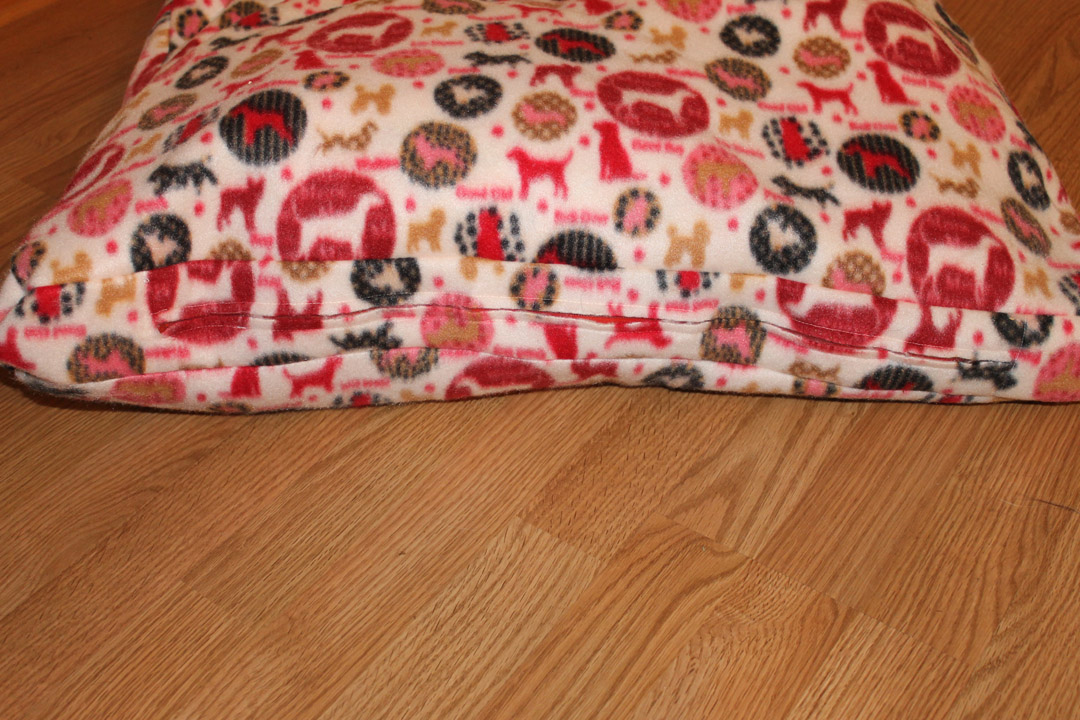
My daughter often comes home to visit me with a project in tow, and this time she wanted a new cover for her well worn dog bed. A minor error in planning gave me an opportunity to rethink my sewing strategy, ending up with a technique that came out great. Many sewing "mistakes" are opportunities to be inventive, and sometimes the solution is better than the standard method.We had planned a square bed made of fleece, about a 36" finished top and bottom with sides of about 3". We planned to put a zipper in the center of one panel so the stuffing could be removed for easy washing. In my hurry, I forgot to cut any of the side panels with a seam in the middle. I was already sewing the side panels together when this was discovered. We had enough fabric to re-cut, but I just didn't want to do it. Then the idea came to me- fleece doesn't fray, so shouldn't I be able to just sew the zipper down the middle and cut an opening? It's quick and fast, keeps bulk to a minimum. It turned out to be the perfect solution.
Since fleece stretches, I wanted to stabilize the panel ends. I cut two pieces of square muslin. I didn't worry about being too exact just yet.
Then I sewed the zipper down the middle on both sides of the teeth. I laid the muslin with the seam allowance even with the zipper tape and sewed right across the end encasing the ends of the zipper. I turned the muslin to the edge, trimmed it to fit. I could have basted it down, but didn't.
Here is a close up of what this looks like. You can see the muslin seam in between. This panel is now stabilized at the ends with the cotton and by the zipper in the middle so the fleece won't stretch out of shape.
This is the right side.
Then I took my tiny sharp scissors and cut down the center between the zipper top stitching.
It's a perfect match- no bulky seams and you can't see the zipper pull unless I open the cut for you.
Here is what the zipper looks like on the finished dog bed.
What do you think? Did it work out well? Never mind that we didn't mind the directional print. Perfection is not necessary. It's a dog bed!
Sadie seems to like it well enough!
I don't sew with fleece much, but if I ever do, I will definitely use this method again!
Saturday, November 3, 2012
Pattern Alterations after Fitting a Muslin
To test the fit of a pattern, sometimes it's wise to make a "muslin" or a sample of your pattern in inexpensive fabric. Cotton muslin is the least expensive of all fabrics, thus the name given to a garment made just for fitting. First make sure the pattern size you picked is right for your measurements. If not, check out my Pattern Resizing Tutorials, Part 1: Small to Large or Part 2: Large to Small. If you make a muslin to make sure your garment fits perfectly, you must also be able to transfer your fitting changes from fabric back to the paper. Here's how to do this, step by step:
1. After your fittings are complete, mark ALL seams, both changed and unchanged. I find that a fine tip permanent marker does a great job because one line down the seam marks both sides for me.
2. Remove all the stitches, darts, seams, everything.
3. Press all pieces flat.
4. Assuming that your pattern is made of transparent paper, lay the paper pattern over the fabric piece. Match up the fabric seam lines that have not changed with your paper pattern seam lines.
5. Here you can see the changes more clearly. The blue mark is the changes on the fabric while the pencil mark is the pattern original. If you are ever left wondering whether to make a change to the paper pattern, remember that the fabric marking always takes priority over the paper marking because the fabric has been tried and proven to fit.
6. Now I need to mark the change with a colored pencil. This helps me to remember where I changed the pattern from the original. I can also keep the original mark to refer back to it if needed.
Here is the change shown clearly.
7. For seams, I must also correct and create a new cutting line. I blend my new line into the old line. You may also need to "true" corrected line. In other words, make sure that your new lines are smooth and straight (or nicely curved), and blended into your original line. I can also put slash marks through the original line to remind me that I don't want to use it. It's an extra assurance.
That's it. Now your pattern is ready to use again!Friday, October 12, 2012
Tissú Fine Fabric Store
Last week I made a sales trip to Salt Lake City, Utah. What a whirlwind of a trip! It took 13 hours to drive across the mostly dry desert lands of Oregon, Idaho, and into Utah. The towns are small and gas stations are few between Boise and Ogden, and we nearly ran out of gas! It was a fast but fun trip, and successful too! Let me introduce you to the cutest boutique in all of Salt Lake Valley called Tissú Fine Fabrics and Design Gallery. The fabrics are top quality, coming from the cutting rooms of well known designers around the U.S., and being sold here at really good prices. You can find a great selection of wools, the most beautiful bridal fabrics, fun and unusual notions, pattern making supplies, sewing classes, and custom sewing and design services. Thank you to my son, Denver, for shooting and editing this great introductory video about Tissú.
If you live nearby, or find yourself passing through, I invite you to stop in, and please tell Teresa I sent you!
Tissú Fine Fabrics and Design Gallery
345 WestPierpont Ave Salt Lake City, UT 84101
Tel. 435 896 7286
If you live nearby, or find yourself passing through, I invite you to stop in, and please tell Teresa I sent you!
Tissú Fine Fabrics and Design Gallery
345 WestPierpont Ave Salt Lake City, UT 84101
Tel. 435 896 7286
Monday, October 1, 2012
The zipper: An American Invention
My son has been doing the filming for our instructional video on zippers. The time it is taking from his daily routine is putting a kink in his social calendar, so with it comes the occasional mild complaint "Why do people have to know about zippers? Isn't there another way?"
Well yes, I explain. We can put button in your pants. That's how it was done in the days before zippers. Or we can go back a little farther to the days when pants were basically two tubes tied together with a cloth tucked between your legs to cover the gap. Or we can go back the farthest - just think! All men (and women) could be wearing a dress right now!
That was it. He was back to the camera without another word.Technology and invention have given us a lot to be thankful for.
While you wait for the video to be completed, I recommend an excellent website that tells the complete and interesting tale of how the zipper came to be. Published by a class of students in "History of American Technology and Culture", HST 325, at the University of Mary Washington in Fredericksburg, Virginia, the history of the zipper is the work of Taylor Brann, which you can find here: http://thezipper.umwblogs.org/
Well yes, I explain. We can put button in your pants. That's how it was done in the days before zippers. Or we can go back a little farther to the days when pants were basically two tubes tied together with a cloth tucked between your legs to cover the gap. Or we can go back the farthest - just think! All men (and women) could be wearing a dress right now!
That was it. He was back to the camera without another word.Technology and invention have given us a lot to be thankful for.
While you wait for the video to be completed, I recommend an excellent website that tells the complete and interesting tale of how the zipper came to be. Published by a class of students in "History of American Technology and Culture", HST 325, at the University of Mary Washington in Fredericksburg, Virginia, the history of the zipper is the work of Taylor Brann, which you can find here: http://thezipper.umwblogs.org/
Saturday, September 15, 2012
Sew a pattern without instructions
If there were no written instructions, would you be able to put a sewing pattern together? This question isn't meant as a quiz for the highly intelligent or for only the practiced seamstress. If you know what all the lines and markings on your pattern are for, your answer should be a resounding YES.These lines and symbols are a pattern makers way of telling you how to assemble the pattern with as few words as possible. You've seen them many times; they lie upon the edges of the cutting line, seam lines, and inside the pattern itself.
Notches are marks found on the cutting line. What they look like will depend upon the program that is making the pattern. They can be triangles, filled or not, or look like clip marks. We use notches ONLY when the shape of a pattern pieces look like another, or if a piece could be easily turned around, or on long seams where stretching or easing could use some guidance.
Symbols come in various types (circles, squares, triangles, lines) and are for interior construction, such as pleats, gathers, ease, and so forth. A symbol usually has a matching partner, and that's why there are so many types. This way we can put circles to circles and squares to squares. Everything should match up perfectly, and sometimes we will add words to the pattern to tell you what that line is for!
I'll use the hip sash section of the Myrtlewood pattern to show you what I mean. Here are two pattern pieces that go together, Piece A and Piece B. One is laid on top of the other. You can't tell that right away, as they are both very different shapes. Pattern Piece A actually has a back piece to it, but we are working with the front half for this example.
On this piece A, you should see darts, notches, symbols, a slash line, and a bent arrow grain line which means you need to cut it out on the fold line, with the grain.
On piece B, you should see pleat fold and match lines, as well as the direction to fold the pleat, symbols, notches, and a diagonal arrow which means that this pattern piece should be cut on the true bias. Bias has the most stretch in the fabric, and if it isn't cut out with the right grain, the pattern piece will not stretch or lay properly. Because these pieces are sewn together on top of each other, the trick is to identify what goes to where. It would be easy to get them mixed up, or one upside down perhaps. It's like putting together a puzzle, and a good idea to figure out how it goes together before you start sewing. If something doesn't match up, it's your cue that you may not have it right.

Here is a view of the front of that pattern a bit larger.
Can you tell what goes to what?
In the next diagram, I've identified what goes to where. Center Front and Center Back notes let you know where the pattern matches in front and back.

Clearly paying close attention to your pattern pieces is essential but you also want the item to fit exactly. If you are working with a pattern that doesn't quite match your proportions, explore my Pattern Resizing Tutorials, Part 1: Small to Large or Part 2: Large to Small.
I challenge you to sew your next pattern together without written instructions. Did you get the messages that the pattern maker was sending you?
Subscribe to:
Posts (Atom)